
What is a Pie Pan Dial? The Vintage Omega Constellation Guide
Ask any serious vintage watch collector to name the most beautiful dial ever fitted to a Swiss dress watch, and a significant number of them will give you the same answer - the pie pan dial Omega Constellation. It is a timepiece that stops people in their tracks, that photographs beautifully and looks even better in person, and that represents vintage Omega watchmaking at its most refined and desirable.
But what exactly is a pie pan dial, where did it come from, and what should you look for if you are thinking about adding one to your collection? Here is everything you need to know.
What Actually is a Pie Pan Dial?

The term pie pan dial refers to a very specific and distinctive dial construction found on Omega Constellation watches produced primarily through the late 1950s and into the 1960s.
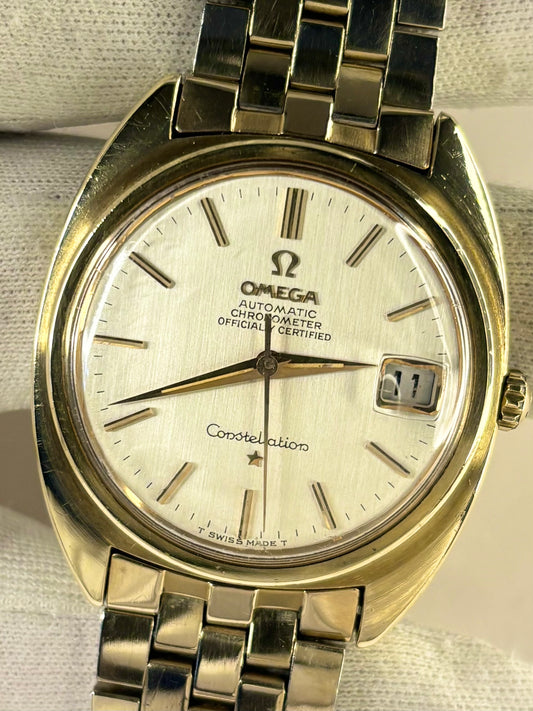
Rather than sitting flat within the case, a pie pan dial has a subtly domed, stepped profile. The outer edge of the dial - where the chapter ring and hour markers sit - is slightly lower than the raised central surface, creating a gentle stepped transition between the two levels. The overall effect is reminiscent of an upturned pie dish, which is exactly where the nickname comes from.
It sounds like a small detail. In photographs it can be difficult to fully appreciate. But hold a pie pan dial Constellation in your hand and the effect is immediately and completely apparent - the dial has a three-dimensional depth and a sense of architectural quality that a flat dial simply cannot replicate. Light falls across it differently depending on the angle, catching the raised centre and casting the subtlest of shadows at the step. It is, without question, one of the most beautiful things ever put inside a watch case.
The Constellation - a Little Background

To understand the pie pan dial, it helps to understand what the Constellation was designed to be.
Omega launched the Constellation in 1952 as their prestige precision timepiece - a watch built to house their finest certified chronometer movements and to demonstrate, in the most visible possible way, that Omega made the most accurate watches in the world. Every Constellation movement was individually tested and certified to the highest accuracy standards by an official Swiss observatory, and the watches were priced and positioned accordingly.
The pie pan dial was conceived as a visual expression of that prestige. The domed, stepped construction was more complex and more expensive to produce than a flat dial, and it gave the Constellation an immediate visual distinction from anything else on the market. Combined with the applied indices, the warm gilt printing, and the beautifully proportioned cases of the era, the pie pan dial made the Constellation one of the most striking and desirable dress watches of the 1950s and 1960s.
Browse our vintage Omega Constellation collection today!
The Golden Era - Late 1950s to Mid 1960s

The most celebrated and collectable Constellations were produced between approximately 1957 and 1966 - a relatively narrow window that produced an extraordinary variety of references and dial configurations.
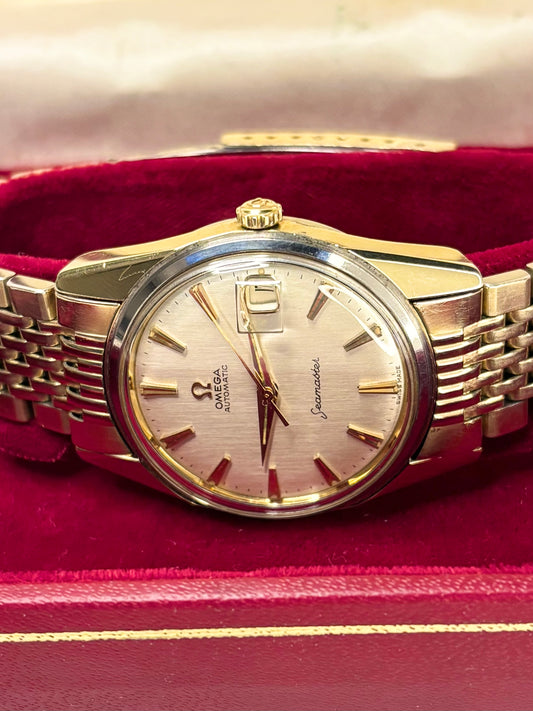
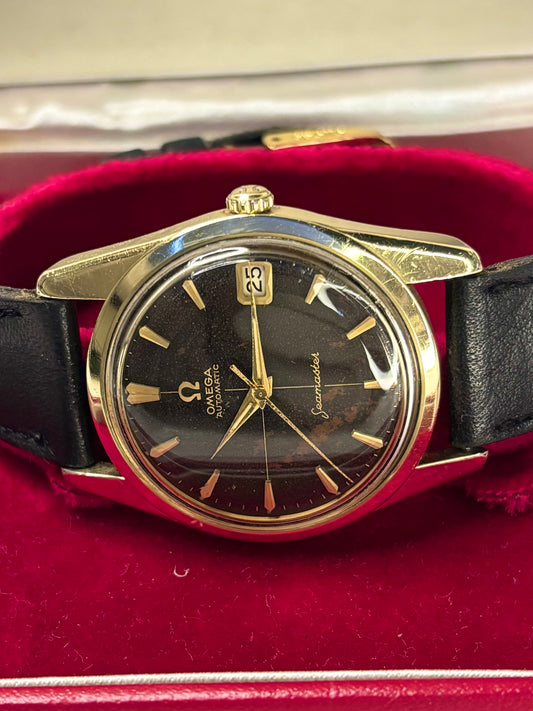
The dials from this period are typically finished in a rich gilt tone - warm, golden, and extraordinarily beautiful when the original patina has developed naturally over sixty-plus years. Applied baton or dagger indices in polished gold catch the light with a brilliance that printed markers simply cannot match, and the overall impression is one of exceptional craft and attention to detail.
The cases that housed these movements are equally distinguished. Many feature the iconic observatory caseback - a solid, non-display caseback engraved with the image of the Geneva Observatory, signalling the precision certification of the movement within. The cases themselves are typically in yellow gold, gold-filled, or stainless steel, and the quality of the metal finishing - with carefully differentiated brushed and polished surfaces - reflects the prestige positioning of the collection.
A particularly lovely detail found on many Constellations of this era is the use of what collectors call the starfish or cross-hair movement holder - a beautifully designed movement ring visible only when the caseback is removed, which holds the movement securely in a way that is as aesthetically considered as it is functional. It is the kind of detail that speaks directly to the care and ambition behind these watches.
How to Spot an Original Pie Pan Dial
Given how desirable pie pan dial Constellations have become, it is worth knowing what to look for when assessing whether a dial is genuinely original and untouched.
The stepped profile itself is the first thing to look at - the transition between the outer chapter ring level and the raised centre should be crisp and clean, not blurred or softened. A refinished dial will often show a slight loss of definition at this step, where the original contour has been partially filled or obscured during the refinishing process.
The gilt surface should show natural, even patina consistent with the age of the watch. As discussed in our guide to vintage watch patina, an original gilt dial develops a warmth and depth over decades that is completely impossible to replicate artificially - and on a pie pan dial, that patina can be truly extraordinary.
Applied indices should sit perfectly flush and even, with no signs of having been disturbed or re-glued. And the lume in the dial plots should match the lume on the hands - same colour, same level of ageing, the same story of time having passed.
Why Collectors Love Them So Much
The pie pan dial Constellation occupies a very particular place in the hearts of vintage watch collectors, and it is not difficult to understand why.
It is, first of all, simply one of the most beautiful watches ever made. The combination of the domed gilt dial, the quality of the applied indices, the elegance of the case proportions, and the quality of the movement within creates a total package that has never really been bettered in the dress watch category - at any price point.
It is also, relative to its quality and desirability, still genuinely accessible. A well-preserved pie pan dial Constellation represents extraordinary value in the current market - a timepiece of genuine historical significance and exceptional aesthetic quality that can be acquired for a fraction of the cost of comparable pieces from certain other prestigious Swiss manufacturers.
And it wears beautifully. The slim case, the modest diameter, and the elegant proportions make a pie pan dial Constellation one of the most versatile vintage dress watches you can own - equally at home beneath a suit cuff or on a premium leather strap for a more casual weekend look.
At AR Collectables, we have a genuine soft spot for the pie pan dial Constellation - it is one of those watches that never fails to make us smile. If you have any questions about a specific reference or would like to know more about any piece in our collection, just drop us a message. 🤝
Browse our full vintage Omega collection today!