
Vintage Omega Movements Explained - A Complete Guide to Every Calibre Family
One of the most rewarding things about collecting vintage watches is the depth of knowledge available once you start looking beneath the dial of a vintage Omega. Omega produced an extraordinary range of movements across the post-war decades - manual-wind and automatic, slim dress calibres and robust everyday workhorses - and understanding which calibre family sits inside a given watch tells you an enormous amount about its character, its era, and its quality.
This guide covers the key Omega calibre families that you are most likely to encounter in vintage watches from the 1940s through to the 1970s. It is not exhaustive - the full list of Omega calibre numbers runs to hundreds of references - but it covers the movements that matter most to collectors of vintage Omega dress watches, and gives you the context to understand what you are looking at when you open a caseback.
The 200 Series - Slim, Elegant Manual-Wind Calibres

The 200 series calibres represent some of the finest manual-wind movements Omega ever produced, and they power many of the most beautiful vintage Omega dress watches of the 1950s.
These are slim, refined calibres designed specifically for elegant dress watch applications - their modest height allowed Omega's case designers to create timepieces of extraordinary thinness and refinement. The calibre 267 and 268 are perhaps the most widely encountered references in this family, found inside a huge range of Omega dress watches and early Constellation models from the mid-to-late 1950s. The 283, 284, and 285 are equally celebrated - slightly later developments within the same family, offering refined timekeeping in an elegantly slim package.
What makes the 200 series so appealing to collectors is the combination of quality and understatement. These movements are beautifully finished for their price tier, reliable in daily use, and they carry a directness and simplicity that is entirely appropriate for the slim, uncluttered dress watches they were designed to power. If you encounter a vintage Omega from the 1950s with a manual-wind movement that keeps excellent time, the chances are very good that a 200 series calibre is responsible.
A 200 series powered vintage Omega dress watch is also, typically, extraordinarily slim on the wrist - a quality that is genuinely rare and genuinely lovely in a world of increasingly thick watch cases.
Browse our vintage Omega collection today!
The 300 Series - Manual-Wind Calibres and the Birth of the Bumper Automatic
The 300 series is a broad family that encompasses both manual-wind calibres and the earliest of Omega's bumper automatic movements - making it one of the most varied and historically significant calibre groups in the entire Omega catalogue.
On the manual-wind side, calibres like the 302 and 310 continued the tradition of slim, high-quality movements suited to dress watch applications through the late 1940s and into the 1950s. These are solid, well-regarded calibres that served Omega faithfully across a wide range of timepieces.
But the real story of the 300 series, for most collectors, is the bumper automatics - the calibres 340, 342, 344, and their variants. These movements, produced through the late 1940s and 1950s, represent Omega's first serious engagement with the self-winding wristwatch format, and they have a character and charm that is completely unique.
As discussed in our post on the history of automatic watch movements, a bumper automatic uses a weighted sector that swings back and forth through a limited arc, winding the mainspring as it goes and producing a gentle, rhythmic thud as it reaches the end of its travel. In the 340 and 342 calibres specifically, this mechanism is beautifully executed - these are movements that feel as characterful as they sound, and they power some of the most appealing vintage Omega Seamasters of the early 1950s.
Finding a vintage Omega with a bumper calibre in good working order is always a genuinely pleasurable experience. The movement has a personality to it that later, more efficient full-rotor automatics cannot quite replicate.
The 400 Series - Refined Bumpers and the Transition to Full Rotor
The 400 series calibres sit at a fascinating transitional moment in the history of Omega automatic movements - bridging the bumper era of the early 1950s and the full-rotor revolution that followed.
Calibres in the 350s and into the 400 series - including the widely encountered 351, 352, 354, and 355 - represent the mature, refined end of the bumper automatic tradition. These are movements that took the lessons learned from the earlier 340 series and applied them with greater precision and efficiency, producing bumper calibres of excellent reliability and quality that powered Omega watches through the mid-1950s.
The 370 and 371 calibres are particularly interesting within this group - representing a high point of bumper automatic refinement before the format was superseded entirely by the full rotor. A vintage Omega Seamaster or Constellation housing one of these later bumper calibres is a lovely and historically significant timepiece - it represents the very last chapter of a movement format that had been in development since the late 1940s.
By the late 1950s, the full-rotor automatic had established its dominance, and the bumper format was gradually phased out across the Omega range. But the 400 series calibres that carried the bumper tradition to its conclusion deserve considerably more appreciation than they typically receive.
The 500 Series - the Greatest Omega Movements Ever Made

If there is one calibre family that sits at the very pinnacle of vintage Omega collecting, it is the 500 series - and the enthusiasm with which collectors seek out watches housing these movements is entirely justified.
Introduced in the late 1950s and produced throughout the 1960s, the 500 series full-rotor automatics represent Omega movement-making at its absolute finest. These calibres combined a beautifully designed full 360-degree rotor with exceptional finishing standards, outstanding reliability, and accuracy that met or exceeded the most demanding certification requirements of the era.
The 550 and 551 are among the most celebrated references in the family, powering Constellation models of the late 1950s and early 1960s in their respective variations. The 552 and 561 are equally revered - the 552 is the movement most commonly found inside pie pan dial Constellations, and its combination of quality, slimness, and reliability makes it one of the most desirable vintage Omega calibres in existence.
The 560 series - encompassing the 560, 561, 562, 563, 564, and 565 - extended the family through the mid-to-late 1960s, bringing in date complications and further refinements while maintaining the exceptional quality standards of the earlier references. The calibre 565, in particular, is a wonderfully accomplished movement that powered a huge range of Omega dress watches through the second half of the 1960s.
What distinguishes the 500 series from what came before and what followed is the totality of the achievement - these are movements where the finishing, the engineering, the reliability, and the accuracy all come together at the same exceptional level simultaneously. Opening the caseback of a vintage Omega and finding a 500 series calibre in clean, original condition is one of the genuine pleasures of vintage watch collecting.
Browse our vintage Omega dress watch collection today!
The 600 Series - Quality Across a New Decade

As the 1960s moved into the 1970s, Omega introduced the 600 series calibres - a new family of automatic movements designed to power their watches through the next decade of production.
The 600 series maintains the quality standards of its predecessors while reflecting the evolving design and engineering priorities of the era. Calibres including the 600, 601, 610, 611, and 613 powered a wide range of Omega dress and everyday watches through the late 1960s and into the 1970s, and they are reliable, well-made movements that reward their owners with consistent, accurate timekeeping.
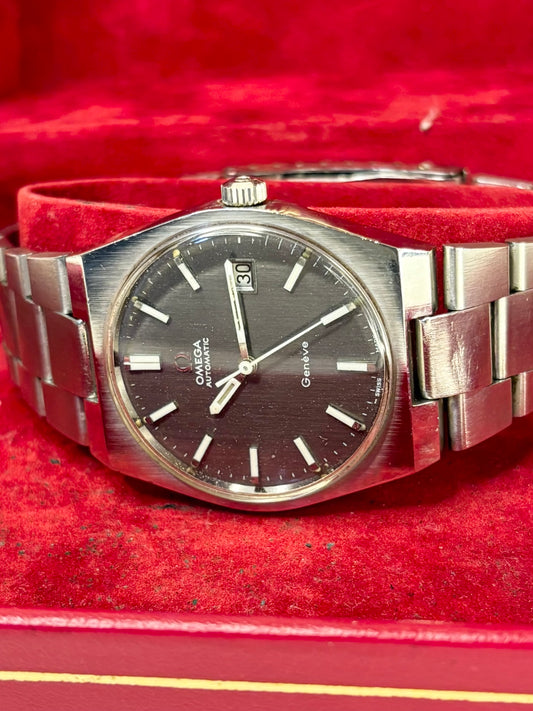
The 620 and 630 series brought date and day-date complications to the family, expanding the functional range of the calibres while maintaining the core quality that had characterised Omega movements throughout the post-war period. The calibre 670 and its variants extended the family further still, and are widely encountered in vintage Omega De Ville and Genève models of the 1970s.
One characteristic of 600 series movements that collectors appreciate is their accessibility - watches housing these calibres are often available at very sensible prices relative to their quality, making them an excellent entry point for anyone building a vintage Omega collection on a considered budget. The movements inside are genuinely capable, and the watches they power are typically handsome, well-made timepieces that wear beautifully on the wrist.
The 1000 Series - Quartz Arrives
No guide to Omega calibres would be complete without acknowledging the arrival of quartz - and in the Omega context, the 1000 series is where that story begins.
The calibre 1300 and its variants represented Omega's move into quartz production in the early-to-mid 1970s, reflecting the industry-wide response to the Quartz Crisis that we discussed in our post on the history of quartz watches. These early Omega quartz calibres were produced to the same quality standards as the mechanical movements that preceded them, and the vintage Omega timepieces housing them are today increasingly interesting to collectors as historical artefacts from one of the most turbulent periods in watchmaking history.
An early vintage Omega quartz watch from this era is a fascinating object - built with all the material quality and finishing care of a prestige Swiss timepiece, but powered by the technology that very nearly ended the mechanical watch industry entirely. That tension gives these pieces a significance that goes well beyond their timekeeping function.
How to Identify Which Calibre is in Your Watch
The most reliable way to identify the calibre inside a vintage Omega is via the number engraved on the movement itself. It is worth noting that movements were occasionally swapped during service over the decades - so the calibre you find inside a vintage Omega will not always be the one it left the factory with. A reputable seller should be able to tell you whether the movement is original to the case, and this is always worth asking about when making a purchase.
At AR Collectables, we are happy to discuss the specific movement inside any watch in our collection in as much detail as you like. The calibre is a fundamental part of the story of a vintage timepiece, and we think it deserves to be understood and appreciated properly. Drop us a message any time. 🤝
Browse our full vintage Omega collection today!