
What is a Screw Down Crown on a Watch? A Complete Guide
If you have ever picked up a water-resistant watch and found that the crown would not pull out to set the time until you first unscrewed it, you have encountered a screw-down crown. It is one of the most important features in the history of the water-resistant watch, and a genuinely clever piece of engineering. But what exactly is a screw-down crown, how does it work, and what should you know about it - particularly on a vintage watch? Here is everything you need to know.
What is a Screw-Down Crown?
A screw-down crown - also known as a screw-lock crown - is a winding crown that screws down onto a threaded tube on the side of the watch case, locking it firmly in place and sealing the watch against water and dust. Rather than simply pushing and pulling in and out like an ordinary crown, a screw-down crown must be unscrewed before it can be used, and then screwed back down to seal the watch again afterwards.
It is, in essence, a crown that locks shut - and that locking action is the key to keeping water and dust out of the movement. It is one of the defining features of a genuinely water-resistant watch.
Why Do Watches Have Screw-Down Crowns?
The purpose is water and dust resistance. The crown is one of the most vulnerable points on any watch - a hole in the case through which the winding stem passes - and it is one of the easiest places for water to get in. A standard push-pull crown relies only on a gasket to keep water out, which is adequate for light water resistance, but a screw-down crown goes much further, physically locking the crown shut and compressing the seals for a far more robust barrier.
This is why screw-down crowns are found on dive watches, tool watches, and any watch designed for serious water resistance, as we discuss in our guide to the tool watch. For a watch that needs to survive real exposure to water, the screw-down crown is essential.
The Rolex Oyster Connection

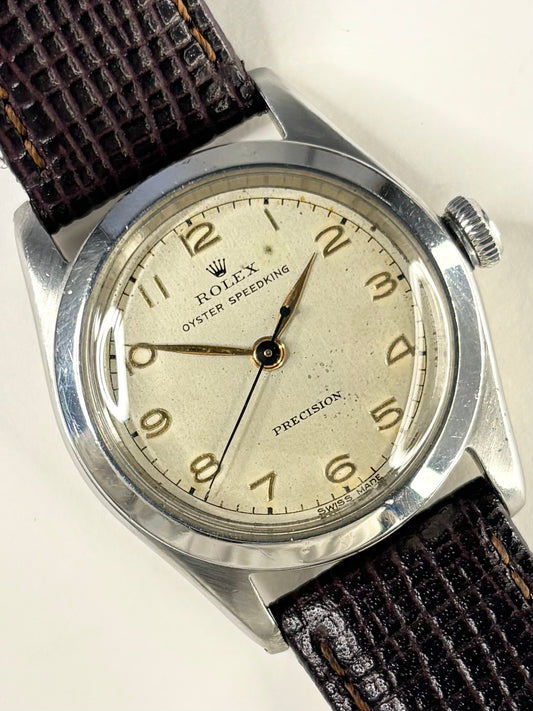
No discussion of the screw-down crown would be complete without Rolex, because it was central to one of the most important watches ever made - the Rolex Oyster. When Rolex introduced the Oyster case in 1926 as the world's first truly waterproof wristwatch, the screw-down crown was one of its key innovations, sealing the most vulnerable point of the case alongside the screw-down caseback and bezel.
The screw-down crown remains fundamental to Rolex to this day, and it is a defining feature of the brand's Oyster-cased watches, as we explore in our complete guide to vintage Rolex watches. A vintage Oyster-cased Rolex carries this genuine piece of horological history on the wrist.
The ROLEX Oyster Perpetual Air-King - Box and Papers - Vintage 1960's Automatic - Reference 5500 is a wonderful example of an Oyster-cased vintage Rolex, complete with the screw-down crown that made the Oyster case so revolutionary - presented here with its box and papers.
Check out our full vintage watch collection today!
How to Use a Screw-Down Crown
Using a screw-down crown is straightforward once you know how. To wind or set the watch, first unscrew the crown by turning it anticlockwise until it releases and springs out to its free position. You can then wind the watch or set the time as normal.
Once you have finished, gently push the crown back in and screw it down clockwise until it is firmly seated - taking care to engage the thread properly and not to force it. This reseals the watch. The golden rule is simple - always make sure the crown is screwed fully down before the watch goes anywhere near water.
Screw-Down Crowns on Vintage Watches - a Caution
Here is an important point for any vintage watch owner. While a screw-down crown was designed to make a watch water-resistant, the same caution applies to it as to every other part of a vintage timepiece - it has aged.
The gaskets inside a vintage screw-down crown are, in all likelihood, decades old, and rubber gaskets perish and lose their sealing ability over time. This means that even a vintage watch with a screw-down crown should not be assumed to be water-resistant today, unless its seals have been recently replaced and the watch professionally pressure-tested. As we explain in our guide to whether vintage watches are waterproof, the sensible approach with any vintage watch is to keep it well away from water, regardless of its original design.
A further practical caution - always take care not to cross-thread a screw-down crown when screwing it back down. Cross-threading can damage the delicate threads on the crown and tube, which is an expensive repair. If the crown does not seem to be screwing down smoothly, unscrew it and try again gently rather than forcing it.
A Final Thought
The screw-down crown is one of the great innovations in the history of the water-resistant watch - a simple, clever mechanism that locks the crown shut and seals the watch against the elements. Central to the legendary Rolex Oyster and found on dive and tool watches ever since, it is a genuinely important feature to understand. Just remember that on a vintage watch, age changes everything, and a screw-down crown is no guarantee of water resistance today.
At AR Collectables, every vintage timepiece in our collection is handpicked, cleaned, and tested. If you have any questions about a specific piece, or are looking to buy a vintage watch, just drop us a message - we would love to help. 🤝
Check out our full vintage watch collection today!