
What Does A.T.P. Mean on a Vintage Watch? The British Military Watch Explained
If you have ever come across a vintage military watch marked A.T.P., or seen the term used in a listing, you may well have wondered what it means. It is one of the most important designations in British military watch collecting, and understanding it opens the door to one of the most accessible and rewarding corners of the vintage watch world. So what exactly does A.T.P. mean, where do these watches come from, and what should you look for? Here is everything you need to know.
What Does A.T.P. Mean?
A.T.P. stands for Army Trade Pattern. It was a designation used by the British military during the Second World War for wristwatches issued to service personnel, and it refers to watches supplied to an approved general specification rather than to a single, rigidly standardised design.
In practical terms, an A.T.P. watch is a British military-issue wristwatch from the earlier and middle years of the Second World War. These were the watches that equipped British servicemen during much of the conflict, and they were supplied by a range of manufacturers - predominantly Swiss - all producing watches that met the military's practical requirements.
The History Behind A.T.P. Watches![]()
To understand A.T.P. watches, it helps to understand the moment they come from. As the Second World War began and escalated, the British military needed to equip vast numbers of servicemen with reliable wristwatches - and it needed to do so quickly and in quantity.
Rather than commissioning a single standardised watch from the outset, the military initially sourced suitable watches to an approved general pattern from numerous manufacturers, mostly Swiss. These Army Trade Pattern watches were the result - practical, functional timepieces that met the military's needs and could be supplied in the numbers required during the earlier and middle years of the war.
Later, in 1945, the military would commission the far more rigidly standardised W.W.W. watches - the celebrated Dirty Dozen, which we cover in our complete guide to the Dirty Dozen. But for much of the war, it was the A.T.P. watch that served on the wrists of British personnel.
How to Identify an A.T.P. Watch

A.T.P. watches share a number of characteristic features that help identify them.
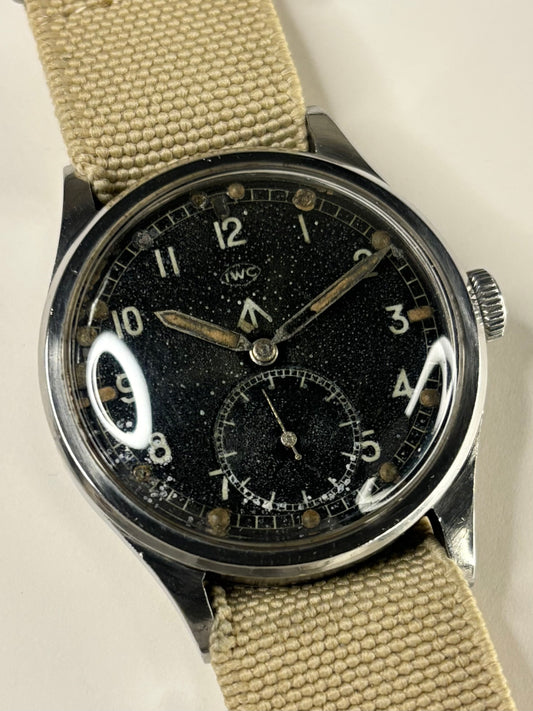
They are typically smaller manual-wind watches, reflecting the conventions of the era, usually with cases in stainless steel or chrome-plated base metal rather than precious metals - these were tools, not jewellery. The dials are clean and highly legible, very often with a subsidiary seconds dial at six o'clock, luminous hands and markers for low-light readability, and a straightforward, no-nonsense design focused entirely on function.
Crucially, genuine A.T.P. watches carry official military markings, typically engraved on the caseback - including the letters A.T.P. themselves, often alongside the British broad arrow mark (a small arrow-shaped symbol) and a military issue number. These markings are the key to identifying and authenticating a genuine A.T.P. watch, and learning to recognise them is essential, as we discuss in our guides to telling if a watch is from WW2 and spotting a fake vintage watch.
A.T.P. vs the Dirty Dozen - What's the Difference?
This is a common point of confusion worth clearing up, because A.T.P. and the Dirty Dozen are related but distinct.
A.T.P. watches came first, issued through the earlier and middle years of the war to a more general approved pattern, supplied by many makers. The Dirty Dozen watches - marked W.W.W. - came later, in 1945, commissioned from twelve specific manufacturers to a single, much stricter standardised specification. Both are genuine British military watches, both carry the broad arrow, and both share the same honest, functional character - but they are separate categories, and knowing the difference marks you out as a knowledgeable collector.
Why A.T.P. Watches Are a Great Place to Start

For anyone drawn to military watches, A.T.P. pieces offer one of the very best entry points, and there are several reasons why.
They are genuinely historic - real British military watches that saw service during the Second World War, carrying a direct connection to that extraordinary period. They are wonderfully honest and characterful, with the purposeful, functional charm that makes military watches so appealing. And crucially, they remain surprisingly accessible - offering genuine wartime history at a price far more attainable than many other military timepieces, including the celebrated Dirty Dozen.
The MOERIS WW2 British Military A.T.P. - 1940's Men's Manual Watch is a lovely genuine example. Moeris was one of the manufacturers that supplied A.T.P. watches to the British military during the war, and this 1940's manual-wind timepiece carries all the honest, purposeful character of a real wartime watch - a tangible piece of history and a wonderful way into military watch collecting.
Check out our full vintage watch collection today!
A Final Thought
The A.T.P. marking on a vintage watch is a genuine badge of history - the sign of a British military timepiece that served during the Second World War. Honest, functional, historically significant, and surprisingly accessible, A.T.P. watches are among the most rewarding of all military timepieces to own and to explore. If you would like to learn more, our complete guide to vintage military watches covers the wider subject in full.
At AR Collectables, we have a real appreciation for the history and character of military timepieces. Every vintage watch in our collection is handpicked, cleaned, and tested. If you would like to know more, or are looking to buy a genuine vintage military watch, just drop us a message - we would love to help. 🤝
Check out our full vintage watch collection today!