
What Does 17 Jewels Mean on a Watch? Jewel Counts Explained
If you have ever looked closely at a vintage watch dial or movement, you may have spotted a curious phrase - 17 Jewels, perhaps, or 21 Jewels, or 25 Jewels. It is one of the most commonly seen and least understood markings in watchmaking, and it leads to a great deal of confusion. Are these real jewels? Do more jewels mean a better watch? What does the number actually tell you? Here is a clear, complete explanation.
What Are Watch Jewels?
Let us clear up the biggest misconception first - the jewels in a watch are not there for decoration, and they are not what gives the watch its value. They are tiny functional components, and they perform a genuinely important job inside the movement.
Watch jewels are small synthetic gemstones - almost always synthetic ruby or sapphire, both forms of the mineral corundum - used as bearings at the points inside a movement where there is the most friction. Since the early twentieth century, these jewels have been manufactured synthetically, which made them inexpensive and consistent, so despite the name there is nothing precious or costly about them. Their value is entirely practical.
Why Do Watches Have Jewels?

To understand the jewels, you need to understand the problem they solve. Inside a mechanical watch, tiny metal pivots spin continuously at high speed, day in and day out, for decades. If those pivots turned directly against metal, the constant friction would cause wear, reduce accuracy, and eventually wear the movement out.
This is where the jewels come in. Hard, smooth, and almost frictionless, synthetic ruby and sapphire make superb bearings. By setting these jewels at the key points of friction - particularly around the fast-moving balance wheel and the gear train - watchmakers dramatically reduce wear, improve accuracy, and greatly extend the working life of the movement. A well-jewelled watch is a watch built to last, which is one reason so many quality vintage timepieces are still running beautifully today.
Why 17 Jewels Specifically?
So why is 17 the number you see most often? The answer is that 17 jewels came to represent a fully jewelled movement - one in which all the key points of friction in a standard time-only watch are fitted with jewel bearings.
A 17-jewel movement places jewels at all the most important friction points - around the balance, the escape wheel, the pallet fork, and the train of gears - leaving no significant point of wear unprotected. For a basic, time-only manual-wind watch, 17 jewels is the mark of a properly made, quality movement, which is exactly why the figure became a recognised standard and a point of pride, often printed proudly on the dial or movement. If you see 17 Jewels on a vintage timepiece, you are looking at a fully jewelled, quality movement.
What About 21, 25 or More Jewels?

If 17 jewels fully protects a basic movement, why do so many watches have more - 21, 23, 25, or even higher? The answer is not that they are better made, but that they are doing more.
Additional jewels are added when a movement has extra mechanisms that introduce new points of friction. An automatic watch, for instance, has a self-winding rotor and its associated gearing, all of which need their own jewelled bearings - so automatic movements typically carry more jewels than manual ones, often 21, 23, 25 or more. Watches with complications such as a date, day-date, or chronograph likewise need extra jewels for the additional parts. So a 24-jewel automatic is not necessarily of higher quality than a 17-jewel manual - it simply has more going on inside, as we explore in our guides to the history of automatic movements and manual-wind movements.
Does More Jewels Mean a Better Watch?
This is the crucial myth to dispel - no, a higher jewel count does not automatically mean a better or more accurate watch. Beyond the functional points that genuinely need jewelling, extra jewels add nothing to a watch's performance.
In fact, during the middle of the twentieth century there was something of a jewel-count race, with some makers fitting non-functional jewels purely so they could print an impressive number on the dial for marketing purposes. This became enough of a problem that standards were eventually introduced to ensure only functional jewels could be counted. The lesson for the collector is simple - judge a movement by its quality, its maker, and how well it runs, not by a high jewel count alone. A fine 17-jewel vintage Omega movement is a far better thing than an unremarkable movement boasting a big number.
Two Quality Vintage Movements From Our Collection

The best vintage watches pair quality, fully jewelled movements with genuine character. Here are two from our collection.
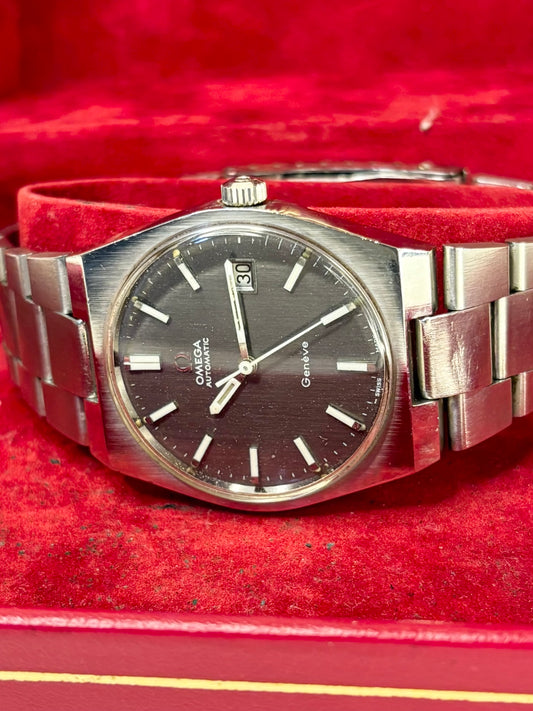
The OMEGA Genève Silver - Vintage 1960's Men's Watch - Reference 136.041 is a lovely genuine vintage Omega timepiece, powered by exactly the kind of quality, well-jewelled Omega movement that has kept these watches running so beautifully for decades.
The LONGINES 9ct Gold Sub-Seconds Watch - Vintage 1960's - Reference 370 is another genuine, characterful classic timepiece - a 9ct gold Longines from one of the most respected names in watchmaking, with the elegant sub-seconds layout so typical of the era.
Check out our full vintage watch collection today!
A Final Thought
The next time you see 17 Jewels on a watch, you will know exactly what it means - a fully jewelled, quality movement, with hard-wearing synthetic ruby bearings protecting every important point of friction. It is one of those small details that, once understood, makes a vintage timepiece all the more fascinating to own. And remember - it is the quality of the movement that matters, not simply the size of the number.
At AR Collectables, every vintage timepiece in our collection is cleaned, tested, and honestly described. If you have any questions, or are looking to buy a vintage watch with a quality movement, just drop us a message - we would love to help. 🤝
Check out our full vintage watch collection today!